
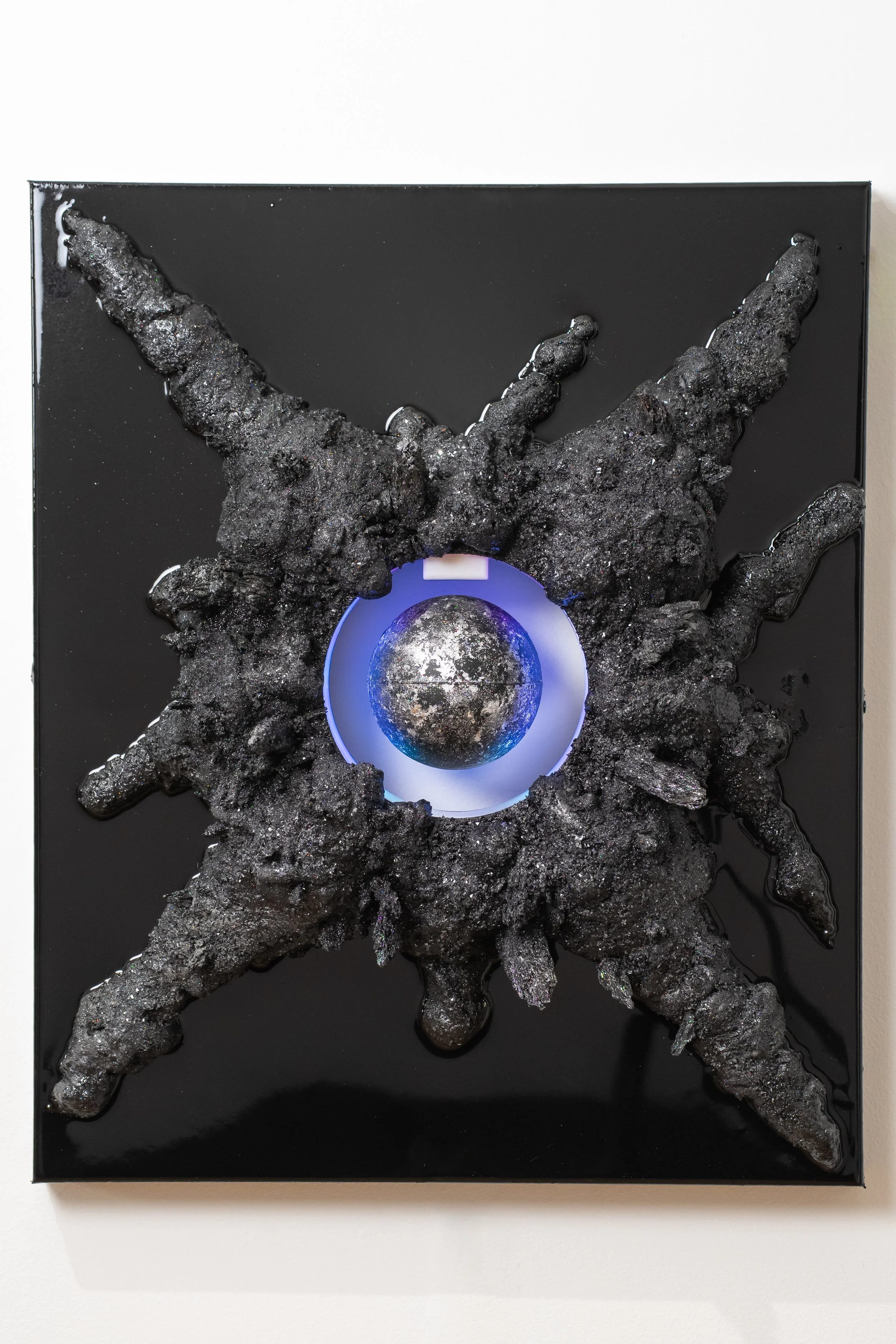
The Lazarus Effect is an exploration of transformation, resurrection, and the infinite cycle of existence. Blending the wonders of science with the mysteries of spirituality, this mixed-media crystal artwork challenges the boundaries between life, death, and renewal.
At its center, an extraordinary orb adorned with Carborundum crystal powder rotates continuously through the power of electromagnetism. Its perpetual motion symbolizes the eternal rhythm of existence—a cycle in which endings become beginnings, destruction gives way to creation, and energy is continuously transformed. Carborundum, scientifically known as silicon carbide, carries a fascinating history. First synthesized in 1891 by inventor Edward Goodrich Acheson during experiments intended to produce artificial diamonds, this remarkable crystalline material emerged from humanity’s pursuit of something extraordinary. Though created through human ingenuity rather than natural geological processes, Carborundum possesses an undeniable brilliance. Its mesmerizing iridescent formations reflect a spectrum of colors, embodying the beauty that can emerge through transformation.
Within contemporary metaphysical traditions, Carborundum is associated with protection, energetic renewal, heightened vitality, and spiritual transformation. Its symbolic significance complements the artwork’s central message: that even through immense pressure, change, and uncertainty, something extraordinary can emerge. The title draws inspiration from the biblical resurrection of Lazarus, representing the possibility of renewal beyond what appears to be an absolute ending. The orb’s continuous electromagnetic rotation becomes a visual metaphor for this phenomenon. Never truly beginning or ending, its movement suggests that existence is not a straight line but an infinite cycle of transformation.
The Lazarus Effect reminds us that an ending is not necessarily the end of existence, but perhaps the beginning of another form.
The Lazarus Effect is an exploration of transformation, resurrection, and the infinite cycle of existence. Blending the wonders of science with the mysteries of spirituality, this mixed-media crystal artwork challenges the boundaries between life, death, and renewal.
At its center, an extraordinary orb adorned with Carborundum crystal powder rotates continuously through the power of electromagnetism. Its perpetual motion symbolizes the eternal rhythm of existence—a cycle in which endings become beginnings, destruction gives way to creation, and energy is continuously transformed. Carborundum, scientifically known as silicon carbide, carries a fascinating history. First synthesized in 1891 by inventor Edward Goodrich Acheson during experiments intended to produce artificial diamonds, this remarkable crystalline material emerged from humanity’s pursuit of something extraordinary. Though created through human ingenuity rather than natural geological processes, Carborundum possesses an undeniable brilliance. Its mesmerizing iridescent formations reflect a spectrum of colors, embodying the beauty that can emerge through transformation.
Within contemporary metaphysical traditions, Carborundum is associated with protection, energetic renewal, heightened vitality, and spiritual transformation. Its symbolic significance complements the artwork’s central message: that even through immense pressure, change, and uncertainty, something extraordinary can emerge. The title draws inspiration from the biblical resurrection of Lazarus, representing the possibility of renewal beyond what appears to be an absolute ending. The orb’s continuous electromagnetic rotation becomes a visual metaphor for this phenomenon. Never truly beginning or ending, its movement suggests that existence is not a straight line but an infinite cycle of transformation.
The Lazarus Effect reminds us that an ending is not necessarily the end of existence, but perhaps the beginning of another form.